 HogwartsLegacyZone
Hogwarts Legacy sequel promises immersive new classes like Muggle Studies, Ancient Runes, and Arithmancy, enriching magical adventures.
As I wander the ancient corridors of Hogwarts in the glow of the 1890s, my mind drifts beyond the standard curriculum of Charms and Defense Against the Dark Arts. The castle whispers of knowledge left untapped, of classrooms that have fallen silent. With a sequel confirmed to be on the horizon, I dream not of inventing entirely new magics, but of rediscovering the rich, forgotten subjects that J.K. Rowling wove into her world—subjects that could transform our journey from a simple quest for power into a true, immersive scholarly adventure.
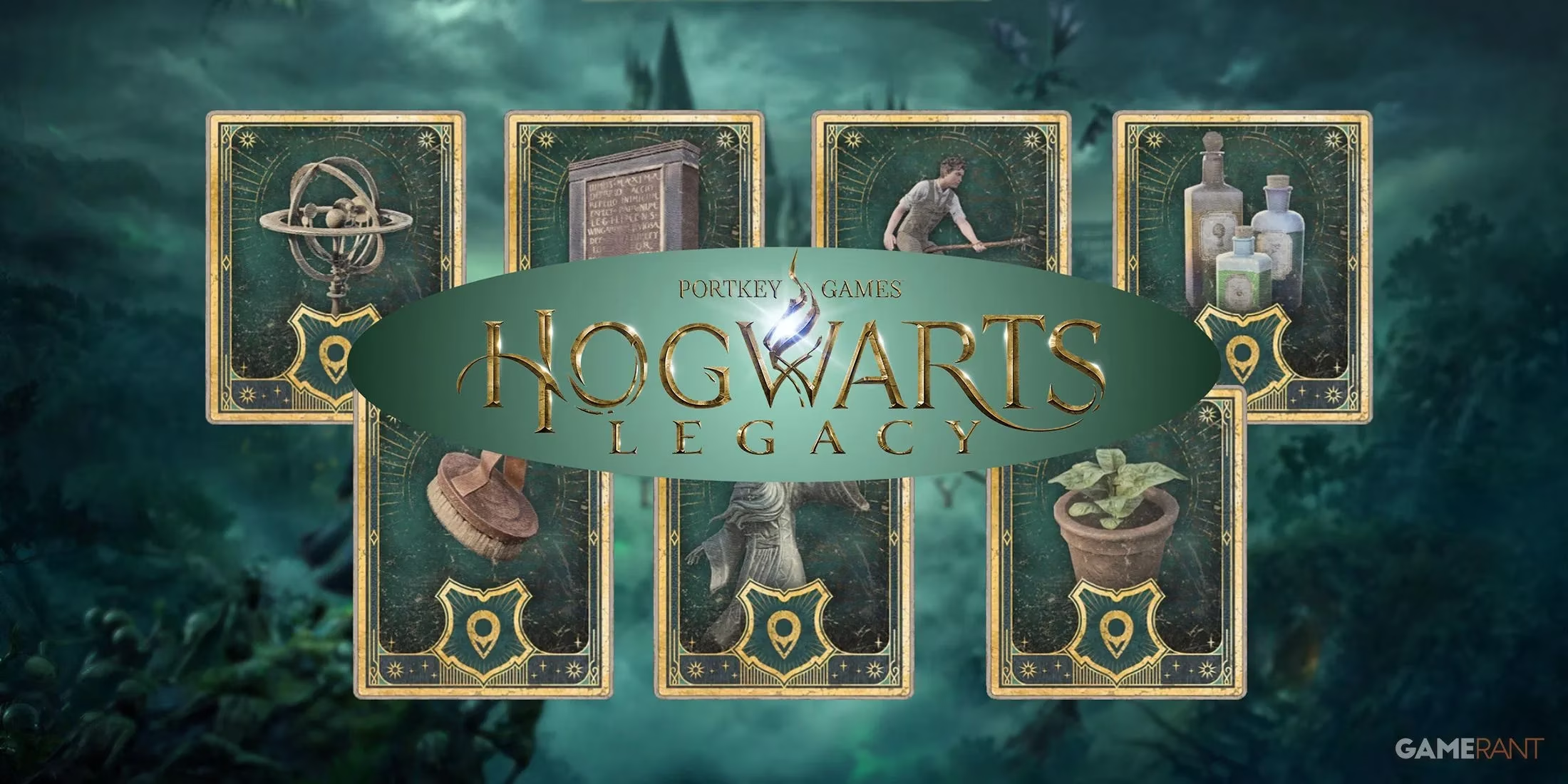
The first game gave us a solid foundation, a core seven: Astronomy ✨, Charms, Defense Against the Dark Arts, Herbology 🌿, Potions 🧪, Care of Magical Creatures (simply called 'Beasts'), and Flying. Each served a clear, utilitarian purpose—a quest to unlock a vital spell like Accio or the essential Levioso. Yet, this very practicality left me yearning. My education felt like a checklist, a means to an end. Where was the wonder of learning for its own sake? The surprise inclusion of History of Magic, even as a side quest, was a flicker of hope. It proved the game could handle a 'text-based' subject, using Professor Binns' droning lectures to beautifully flesh out the lore of our 1890s setting. This is the gateway. If we can study ghosts and goblin rebellions, why not the rest?
Let us first step into the most tantalizingly mundane classroom of all: Muggle Studies. In our era, the 1890s, the Muggle world is on the cusp of its own revolution—telegraphs, early automobiles, the dawn of cinema. Imagine the curriculum not as a joke, but as a vital, fascinating contrast. A class quest could involve:
-
Field Observation: Using Disillusionment Charms to safely observe a Muggle village or London street, sketching their strange, non-magical contraptions.
-
Theoretical Exams: Puzzles based on explaining electricity to a wizard ('It's not lightning in a wire!') or the function of a 'suffragette'.
-
Practical Misadventures: Perhaps a final project where we must cleverly use a simple Muggle item (a pocket watch, a magnifying glass) to solve a magical problem, teaching us that ingenuity transcends worlds.
This wouldn't just be comic relief. It would ground our magical experience, making the wizarding world feel more real by defining its boundaries. It's the perfect subject to add depth without necessarily unlocking a combat spell.
Then, there are the cerebral arts, the subjects that made Hermione Granger's course schedule so intimidating: Ancient Runes and Arithmancy. These aren't about waving wands; they're about decoding the universe's hidden language. The game has already dabbled with Arithmancy-style door puzzles! These subjects are ripe for expansion into core gameplay mechanics.
For Ancient Runes, picture this:
A dusty classroom filled with stone tablets. Our quest begins with translating simple runic phrases—Ansuz for communication, Raidho for journey. This unlocked 'runic sight' could then be used throughout the open world. Suddenly, those mysterious carvings on a dungeon wall or a forgotten monument in the Forbidden Forest become legible, revealing hidden passages, warning of traps, or telling the story of a long-dead witch. A major story dungeon could be built entirely around runic logic, where translating a sequence in the correct order is the only way to proceed.
Arithmancy, the magic of numbers, could be even more transformative. The class itself would teach numerological principles—the magical properties of numbers, how to calculate name numbers, predict magical affinities. The gameplay payoff? A dynamic, personalized puzzle system.
-
A locked chest requires you to calculate your own 'life path number' based on your character's creation date to find the combination.
-
A secret room's door vanishes and reappears based on a Fibonacci sequence you must identify in the environment.
-
Advanced Arithmancy could even influence spell crafting or potion brewing, calculating optimal magical intervals for maximum potency.
| Potential New Class | Core Gameplay Loop | Reward (Non-Combat) |
|---|---|---|
| Muggle Studies | Observation, Theory, Cultural Puzzles | Lore Expansion, Unique Dialogue Options |
| Ancient Runes | Translation, Environmental Decryption | 'Runic Sight' Tool, Access to Secret Areas |
| Arithmancy | Numerical Puzzles, Personalized Calculations | Puzzle-Solving Mastery, Enhanced Crafting |
My hope for the sequel is a Hogwarts that breathes with academic life beyond the core essentials. I want to choose electives that shape my witch or wizard's identity. Will I be a Runes scholar, deciphering the castle's oldest secrets? A Muggle Studies enthusiast, bridging the gap between worlds? These niche subjects offer pathways to specialization and role-playing that the first game only hinted at.
The beauty lies in their foundation in the source material. We're not asking for alien magics; we're asking to sit in the classrooms Harry Potter merely walked past. By weaving Muggle Studies, Ancient Runes, and Arithmancy into the fabric of the sequel—as full class quests with meaningful, exploratory gameplay rewards—Avalanche can deliver the truly holistic Hogwarts experience we dream of. One where learning is its own adventure, and every corner of the castle holds a lesson waiting to be unearthed. Until then, I'll be here in the library, scouring the old texts, dreaming of the day these forgotten classrooms finally open their doors to us once more 📚✨.