 HogwartsLegacyZone
Hogwarts Legacy Alohomora lockpicking offers magical thrills but repetitive loot and mundane rewards diminish the open-world experience.
I still vividly remember the thrill of discovering my first locked door in Hogwarts Legacy back in 2023. The ornate iron gate in the Faculty Tower whispered promises of secret chambers, rare loot, and untold mysteries. My wand hand trembled as I flicked through my spell wheel, selecting the freshly acquired Alohomora. A brief shimmer of brilliant blue light erupted from the tip, and then—click—the lockpicking minigame appeared. That clicking moment has haunted my wizarding dreams ever since.
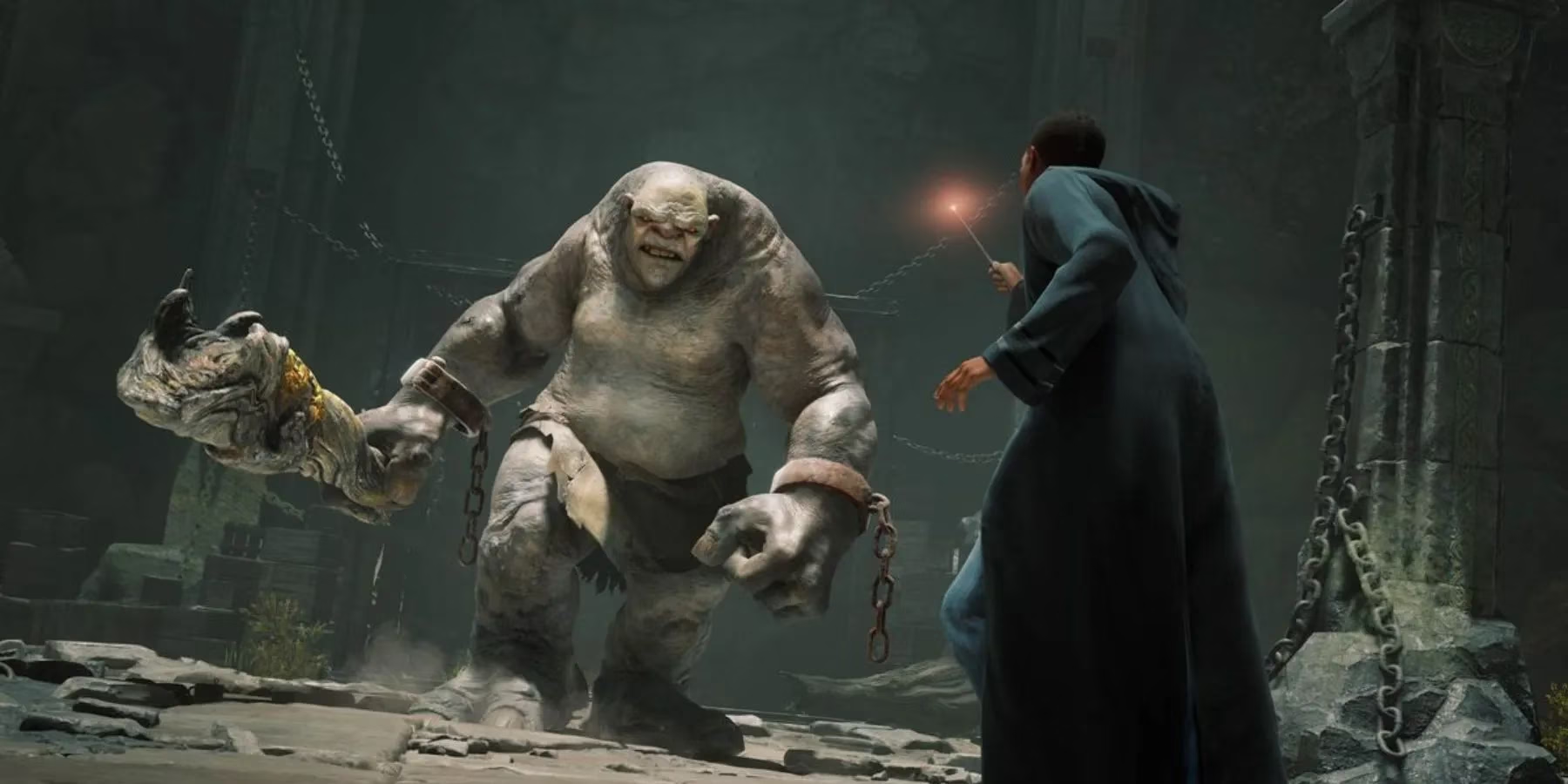
In the summer of 2026, I’ve had plenty of time to reflect on my months spent roaming the Scottish Highlands and the hallowed halls of Hogwarts. Don’t get me wrong: I still adore the game for its breathtaking depiction of the castle, the joy of flying a broomstick over the Black Lake, and the sheer magic of dueling dark wizards. Yet every time I recall Alohomora, I feel a pang of disappointment. The charm, so iconic in the broader Harry Potter lore, became for me a symbol of everything that went slightly askew with the open-world loot grind.
At first, the lockpicking felt whimsical. I’d rotate the inner ring of green sparks and the outer ring of red sparks, aligning them with the turning gears, all while listening for that satisfying whir of lock tumblers. But by my twentieth locked chest in some nondescript bandit camp, the whimsy had evaporated. My hands turned mechanical, my eyes glazed over. The minigame, though mercifully skippable on Story Mode, was far from an engaging puzzle. It reminded me of the dreary lockpicking in countless other role-playing games—a forced ritual that pulled me out of the immersive wizarding world and into a stripped-down, repetitive chore.
But the true letdown wasn’t the minigame itself; it was the treasures hiding behind those locks. I cannot count how many times I wrestled with a triple-tier Alohomora lock, my heart racing with anticipation, only to uncover a common green scarf with a +2 defense rating. It would be identical to three scarves already clogging my inventory, just reskinned with a marginally different plaid pattern. The same held true for locked chests in remote caves or behind secret walls—gear that felt like copy-paste filler rather than magical artifacts worth of a Hogwarts student’s perseverance.
This problem ran deeper than Alohomora, of course. Much of the open-world exploration suffered from what I’ll call the curse of the mundane. I’d cast Revelio every few steps to highlight interactive objects, only to find yet another field guide page or a chest containing gear I’d soon discard. The lockpicking spell became a gatekeeper not to hidden adventures, but to a treadmill of trivial stat bumps. It transformed what should have been a moment of wonder—“What secret does this locked door guard?”—into a weary sigh before the inevitable anticlimax.
In the books and films, Alohomora is a thrilling device that unravels mysteries: Hermione unlocking the forbidden third-floor corridor, or breaking into the Department of Mysteries. The charm should grant access to places unseen, conversations unheard, and secrets that make your wizard or witch feel uniquely clever. Yet in the 2023 game, the spell rarely delivered that narrative punch. I longed to use Alohomora on the entrance to the Hufflepuff common room (as a nosey Ravenclaw, that would have been a delight), or to slip into a professor’s private study after midnight and piece together a scandalous subplot. Instead, I unlocked cupboard after cupboard of forgettable loot.
Three years later, with rumors of a Hogwarts Legacy sequel swirling through the grapevine in 2026, I find myself cautiously hopeful. Avalanche Software now has the chance to reimagine Alohomora as the key to narrative and environmental discovery. Imagine this: you stumble upon an ancient, ivy-choked door in the bowels of the dungeons. Casting Alohomora doesn’t trigger a minigame—it triggers a shift in the world. The door swings open to reveal an abandoned classroom filled with moving portraits that share forgotten wizarding lore, or a hidden dueling society that offers a unique combat challenge. The reward isn’t just a stat-enhanced robe; it’s the experience itself, a story fragment you’d miss otherwise.
To be fair, Hogwarts Legacy did make an effort to differentiate its lock tiers (I, II, III) and required players to collect Alohomora moon statues to upgrade the spell. The concept hinted at progression gating, which I appreciated. Yet the execution never matched the promise. If the sequel ties each tier of Alohomora to distinct, handcrafted areas rather than randomized loot pools, it could transform from a nuisance into a beloved tool. Perhaps Alohomora II unlocks access to a secret passage between Hogwarts and the Forbidden Forest, while Alohomora III grants entry to a hidden observatory at the top of Ravenclaw Tower where a celestial puzzle awaits.
The open-world genre has evolved since 2023, too. Many contemporary titles now emphasize environmental storytelling over loot showers. As a wizard-explorer in 2026, I want to feel that unlocking a door carves a new story for me, not that it simply adds another trinket to my inventory. I want to press my ear against ancient wood, cast Alohomora, and hear whispers of a long-lost house-elf rebellion, or step into a chamber that reveals the origin of the cursed vaults.
So, as I dust off my wand and prepare for whatever magical adventure comes next, I’ll keep my expectations tempered but my imagination alight. Alohomora could be more than a lockpick—it could be the spell that reminds me why I fell in love with the wizarding world: the promise that behind every locked door lies a story worth discovering.