 HogwartsLegacyZone
Hogwarts Legacy Nintendo Switch port showcases technical achievement but exposes hardware limitations, with visual and gameplay compromises evident.
The arrival of Hogwarts Legacy on Nintendo Switch represents both a technical achievement and a stark reminder of the platform's hardware limitations. Avalanche Software's ambitious wizarding world adventure has made its way to Nintendo's hybrid console, but the journey hasn't been without significant compromises. Players embarking on this magical experience on Switch will find a version that, while functional, clearly demonstrates the growing gap between modern gaming demands and the aging Switch hardware.
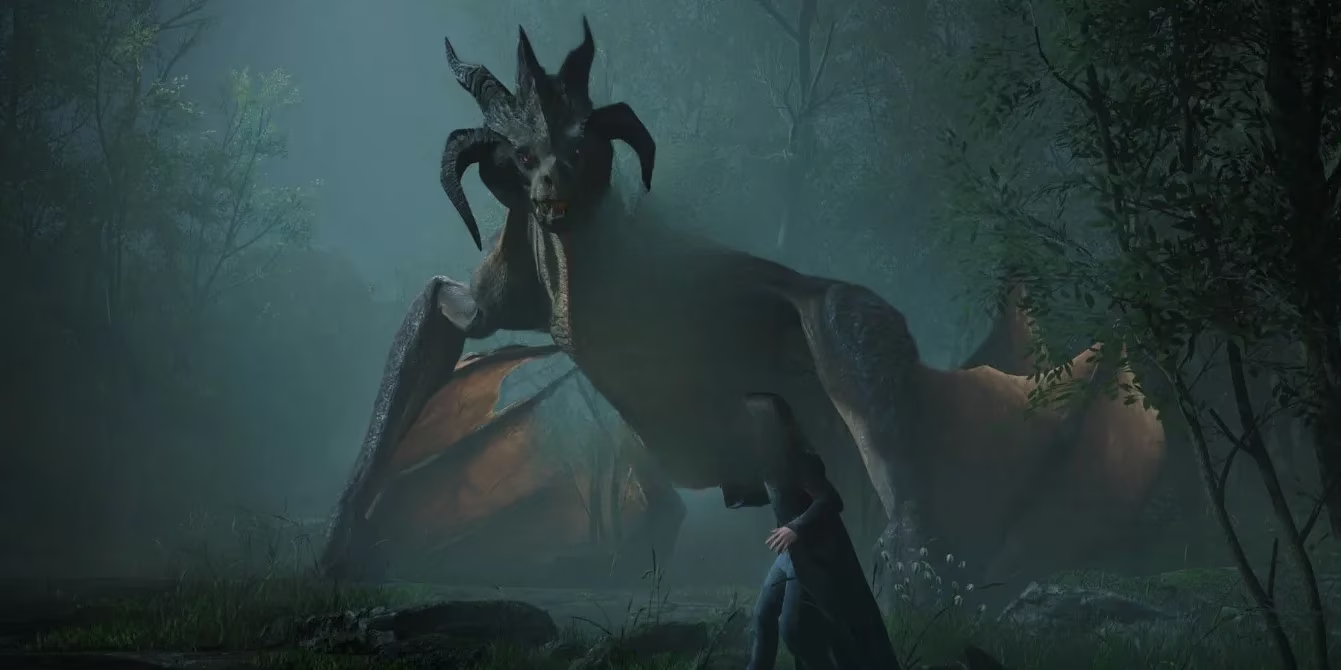
Visual Compromises Become Apparent Immediately 🔍
Upon launching the game, Switch players immediately notice the visual downgrades required to make Hogwarts Legacy run on the system. The lush Scottish landscapes that captivated players on other platforms have undergone significant reductions in detail and texture quality. Where other versions showcase rich, vibrant environments filled with intricate details, the Switch rendition presents:
-
Reduced resolution that falls short of modern standards
-
Muddier textures throughout the game world
-
Minimized draw distances affecting environmental immersion
-
Lower level of detail across characters and environments
These visual compromises extend to performance metrics as well. The game struggles to maintain consistent frame rates, particularly in areas with high visual density or complex magical effects. While the core magical experience remains intact, the visual presentation clearly illustrates the technical boundaries of the Switch hardware.
Structural Changes Impact Gameplay Flow
Perhaps more disappointing than the visual downgrades are the structural changes made to accommodate the Switch's technical limitations. Unlike the seamless open-world experience offered on other platforms, the Switch version introduces numerous loading screens that disrupt the natural flow of exploration:
| Location Transition | Other Platforms | Switch Version |
|---|---|---|
| Hogwarts to Hogsmeade | Seamless | Loading Screen |
| Building Entrances | Immediate | Separate Loading |
| Major Area Changes | Continuous | Interrupted Flow |
This compartmentalized approach means players frequently encounter interruptions during what should be fluid exploration. The magical journey through Hogwarts and its surrounding areas becomes a stop-start experience rather than the continuous adventure found on more powerful systems.
The Bigger Picture: Switch Hardware Limitations 💡
Hogwarts Legacy's Switch port serves as a microcosm of the broader challenges facing Nintendo's platform. While the Switch has demonstrated remarkable longevity and hosted numerous "miracle ports" like The Witcher 3, the hardware's age is becoming increasingly apparent. The console that launched in 2017 with technology already considered dated now struggles to accommodate cutting-edge AAA titles without significant compromises.
What's Lost in Translation 📉
TheSwitch version misses several key elements that contributed to Hogwarts Legacy's appeal on other platforms:
-
Atmospheric immersion suffers due to technical constraints
-
Visual spectacle of magical effects is diminished
-
Exploration freedom is hampered by loading requirements
-
Environmental details that brought the world to life are reduced
Despite these limitations, the mere fact that Hogwarts Legacy runs on Switch represents an engineering achievement. Avalanche Software has managed to preserve the core gameplay experience, including:
✅ Comprehensive spellcasting system
✅ Main story progression
✅ Character customization options
✅ Core magical mechanics
Looking Forward: The Need for Hardware Evolution 🔮
Hogwarts Legacy's arrival on Switch highlights the growing urgency for Nintendo to introduce more powerful hardware. While first-party Nintendo titles continue to shine through clever optimization, third-party AAA games increasingly require substantial compromises to function on the platform. The success of this port demonstrates that developers can work miracles with limited hardware, but also underscores that Switch owners deserve access to modern gaming experiences without such significant trade-offs.
As the gaming industry continues to advance, the gap between what's possible on modern hardware and what can be achieved on Switch will likely widen further. Hogwarts Legacy stands as both an impressive technical accomplishment and a clear signal that the current Nintendo hardware generation is approaching its functional limits for demanding third-party titles.
The magical world of Harry Potter remains accessible to Switch owners, but the experience comes with noticeable sacrifices that may affect player immersion and enjoyment. For those exclusively gaming on Nintendo's platform, it represents another example of making do with compromised versions of cutting-edge games—a pattern that many hope will change with Nintendo's next hardware iteration.