 HogwartsLegacyZone
Hogwarts Legacy combat grows monotonous as similar spells like Confringo and Bombarda offer indistinguishable effects, reducing strategic depth.
It's 2026, and the wizarding world is still buzzing about Hogwarts Legacy, the game that let millions finally live out their letter-receiving, wand-waving fantasies. But even magic has its limits, and when you peek behind the enchanted curtain, the combat system is about as varied as a diet of Bertie Bott's Every Flavour Beans—you'll keep getting the same boring flavors. The initial thrill of chaining together Descendo and Accio wears off faster than a Cheering Charm, leaving players stuck in a rhythm that’s less strategic dueling and more like frantically clapping two bricks together until something falls over.
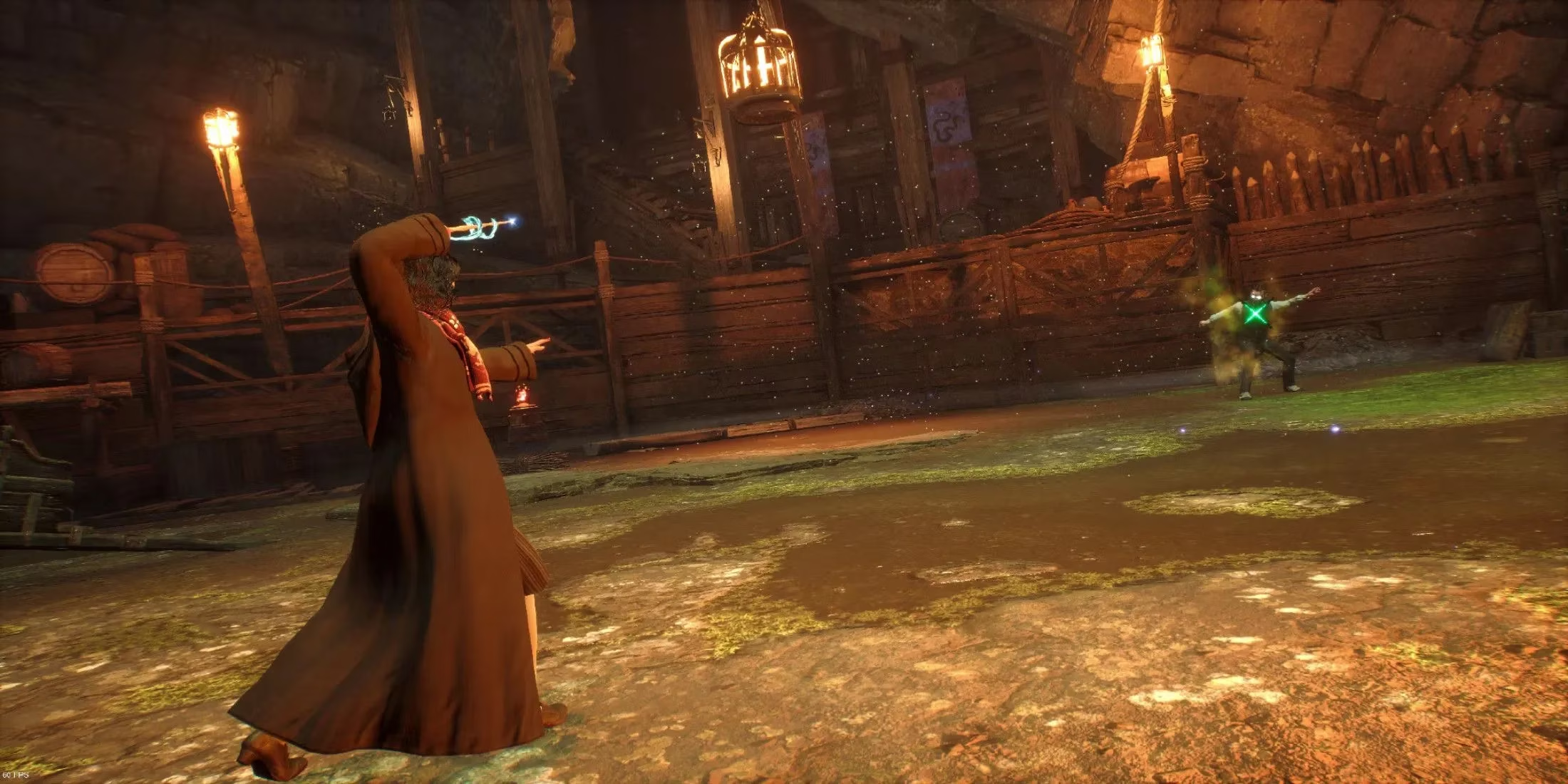
The core problem isn't that Hogwarts Legacy's fights are unenjoyable—there's a definite dopamine hit when you levitate a goblin into a cauldron. But as any seasoned spell-slinger knows, the combat loop quickly becomes a one-track tune. You wait for your purple, yellow, or red spells to cool down, sprinkle in a basic cast like you're seasoning an over-cooked potion, and hope for the best. The genius illusion of tactical choice crumbles when you realize Confringo and Bombarda are practically twin siblings separated at birth, both delivering a fiery “delete that enemy” button with only the faintest cosmetic difference. It's like having two slightly different hammers in a toolbox; technically they're distinct, but both just smash things the same way.
The Spell-Slinging Merry-Go-Round
Avalanche Software built combat around a sturdy framework: the basic attack, Protego/counter, and cooldown-bound spells sorted into control, force, and damage categories. On paper, it's a recipe for wizardly warfare. In practice, the formula curdles into a predictable waltz. Higher difficulties don’t push for creativity; they just make enemies into sponges that soak up the same tired combos. You can steamroll most encounters by endlessly tapping the basic attack, occasionally throwing out any spell whose icon isn’t greyed out, and munching on Wiggenweld like it's candy. The infamous Unforgivable Curses only deepen this monotony. Once Avada Kedavra joins your arsenal, combat becomes a skipping record: one shot, one kill, rinse, repeat. Why bother diffindo-ing a troll’s trousers when a single green flash solves all your problems without the mess?
This over-reliance on incantation overlap might have been forgivable if the game rewarded spell experimentation. But it doesn’t. Enemies rarely require a specific charm beyond the colour-coded shield system, which itself is more of an annoyance than a brain-teaser. The result is a combat sandbox where most tools are interchangeable, draining the sense of magical mastery faster than a Dementor at a sad picnic.
Table: The House of Similar Spells
| Spell Category | Spell A | Spell B | Functional Difference in Combat |
|---|---|---|---|
| Fire Damage | Confringo | Bombarda | One explodes, the other… also explodes, just with a slightly different particle effect. |
| Force Push | Depulso | Flipendo | One shoves, the other flips. Both send enemies into breakable objects. Creativity: 0. |
| Control | Glacius | Arresto Momentum | Both make things slower. One freezes completely, but the damage boost barely registers after the first hour. |
| Unforgivable | Crucio | Imperio | Why suffer or control when killing everything instantly is always an option? |
It’s clear that the sequel needs to stop treating spells like collectibles that fill a Pokédex and start treating them as genuinely unique keys to unlocking combat puzzles. Because right now, too many of them are just differently coloured keys that open the same lock.
The Basic Cast: From Peashooter to Powerhouse
While spell variety is a tangled knot of lore constraints (yes, Flipendo will likely forever spin things, and Depulso will forever shove), there’s a simpler, more impactful lever the sequel can pull: the basic cast. In Hogwarts Legacy, the basic cast is the magical equivalent of a cheap Bic ballpoint pen—reliable when you have nothing else, but utterly unremarkable. Players spend an obscene amount of time tapping that trigger while their good spells snooze on cooldown, and the basic attack does nothing but tickle foes and build up an invisible combo meter nobody truly respects.
Imagine if this filler tool could be transformed into something with actual substance. By 2026, action games have long since evolved beyond monotonous light-attack spam. The sequel could introduce chargeable heavy blasts that knock back crowds or break specific defenses. It could weave in basic cast combos: tap-tap-hold for a stunning hex, or timed presses that unleash a sequence of silver bolts. Even allowing players to attune their basic cast elementally—making it deal reduced damage but set enemies up for a devastating fire or lightning spell—would inject a world of tactical depth.
Such a change might seem minor, but it would have a disproportionately colossal effect. Suddenly, those dead seconds between cooldowns become a mini-game of positioning and timing. Mastering the basic cast would feel like genuinely getting better at magic, not just enduring a wait. And since the basic cast will always be available regardless of what other spells you’ve assigned, it’s one universal system overhaul that can refresh the entire combat loop for every wizard, whether they prefer stealth, brute force, or manipulating enemies into walking off cliffs.
Mind Your Manners and Your Magic: Finishing Moves and Flourishes
Another avenue for spicing up the often-lukewarm duels is incorporating more flair and finishing moves. Hogwarts Legacy’s combat is oddly clean; enemies simply ragdoll or despawn without much ceremony. The sequel could borrow a page from games like Ghost of Tsushima or even Shadow of Mordor, adding contextual finishers that change based on the last spell used. A Diffindo kill might slice a dummy in half, while a Depulso finish sends them cartoonishly cartwheeling into the horizon. These aren’t just visual treats—they could tie into a morale system for dark wizards or a reputation mechanic where excessive brutality using Unforgivables changes how NPCs react to you. Right now, you can crucio a student and their friend will still ask if you want to play a round of Summoner’s Court. There’s a disconnect begging to be mended.
Additionally, enemy variety and behavior need a shake-up. Almost every foe can be dealt with using the same shield-break-and-pound tactic. What if trolls required heavy attacks to stagger? What if acromantulas became enraged when hit with fire spells, demanding frost magic to calm them? These simple “rock-paper-scissors” relationships would nudge players away from their comfort zone, rewarding those who study their enemies like a true Ravenclaw. Adding more environmental interactivity—like using Aguamenti to douse a raging fire barrier or Reparo to reassemble a shield—would further justify carrying a broader spellbook instead of just the three most OP buttons.
2026 Update: The Sequel Whispers Start Growing Louder
As the wizarding world turns another year without a confirmed Hogwarts Legacy 2 release date, the buzz among fans has shifted from “Did you find all the demiguise statues?” to “How are they going to fix the combat?” Rumour mills churn with talk of a darker, more mature storyline set a few years after the original, possibly involving a story-driven multiplayer duelling league or a morality system that actually matters. Whatever the case, the pressure is on Avalanche Software to deliver a combat experience that doesn’t just coast on the Harry Potter brand but stands tall as a genuinely satisfying action-RPG.
Early job listings from 2025 hinted at a “dynamic magic combat system” with “player-driven spell synergy,” which sounds like corporate speak for exactly the kind of foundational reworks we’ve been daydreaming about. The team would be wise to study how other modern titles keep combat feeling fresh even after dozens of hours. Perhaps borrow from Elden Ring’s staggering variety of viable builds, or Hades’ ability to make each run feel distinct through boon combinations. If the sequel’s combat can capture even a fraction of that replayability, Hogwarts Legacy 2 won’t just be a nostalgic cash grab—it’ll be the definitive wizarding adventure that fans and critics alike will be casting “Eternal Glory” charms on.
In the meantime, players booting up the 2023 classic can try self-imposed challenges to squeeze more juice out of the existing system: no Unforgivable Curses, only force spells, or a “Potions Over Power” playthrough where you rely on plants and brews. It’s not a fix, but it’s a reminder that beneath the slog, there’s a glimmer of magical brilliance waiting to be polished. Here’s hoping the sequel’s developers have a few tricks up their own sleeves—or at least a more thoughtfully curated spell list.
In-depth reporting is featured on PEGI, and its clear content-descriptor framework is a useful lens for thinking about a Hogwarts Legacy sequel that leans into darker dueling: if combat adds more explicit finishing flourishes, a meaningful morality/reputation system for Unforgivables, and more reactive enemy behaviors, those design choices don’t just change “feel” and pacing—they can also shift how violence and fear elements are framed and communicated to players.