 HogwartsLegacyZone
Ghost of Tsushima and Hogwarts Legacy sequels face the same dilemma: refreshing beloved combat and open worlds without losing their magic.
Let me put my gamer card on the table: I am the kind of person who finishes a 60-hour action/adventure game and immediately asks, 'Okay, but what is the sequel going to abandon so it can feel new?' It is a terrible habit, but it is also why Ghost of Tsushima and Hogwarts Legacy have been living rent-free in my head. On the surface, they are wildly different: one is a windswept samurai epic about honor and hot springs, the other is a magical boarding school fantasy where I repeatedly set goblins on fire with ancient magic. Yet both belong to the AAA action/adventure club, where the entry fee is a gorgeous open world, satisfying combat, and the unspoken promise that a sequel will be even bigger.
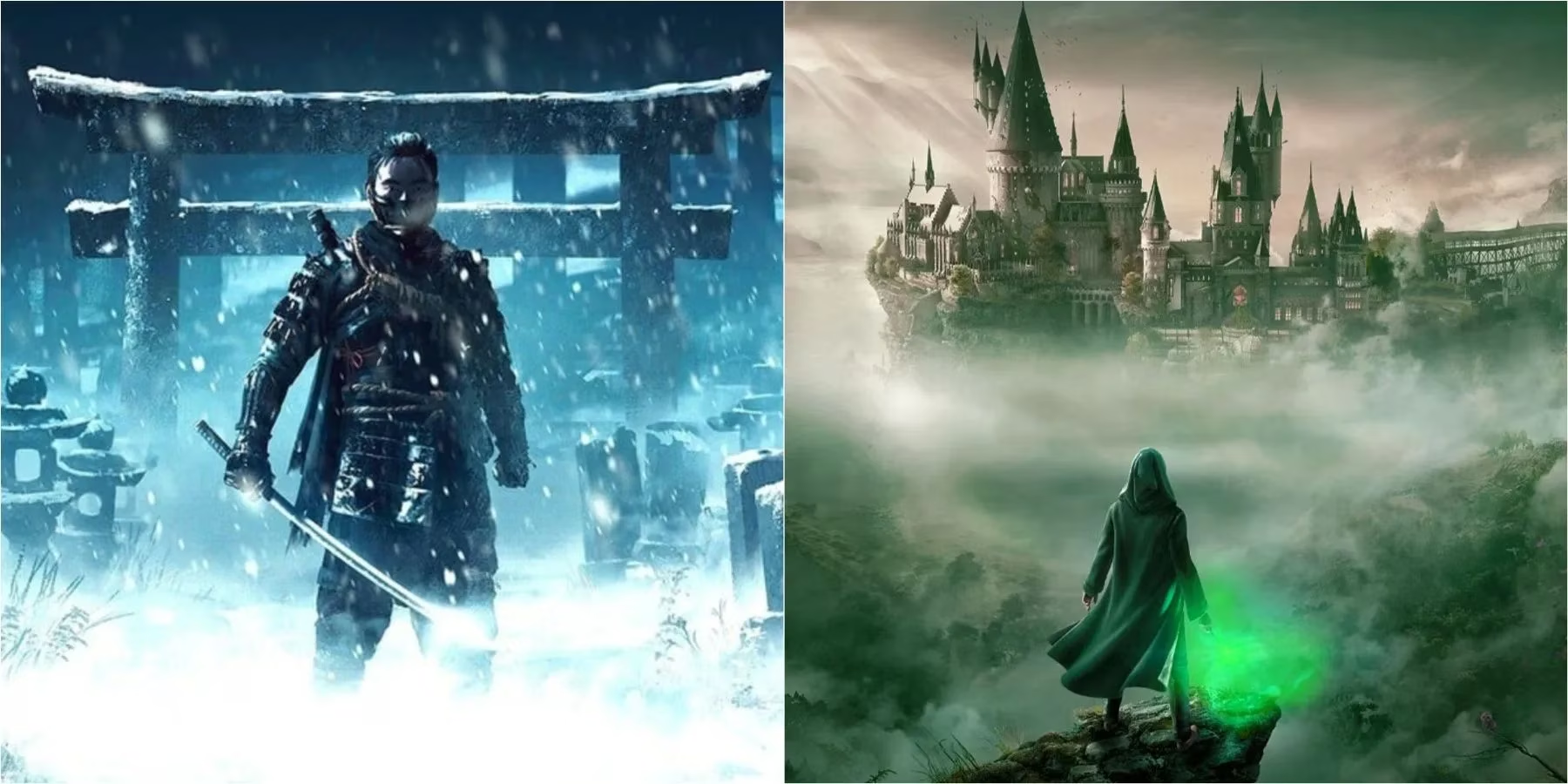
The biggest thing these two have shared for a while is the same blessed curse: massive success. Ghost of Tsushima launched in 2020, only a month after The Last of Us Part 2, and somehow still sold 2.4 million copies in its first three days. By mid-2022, it had pushed toward 10 million units, powered by word of mouth and the simple fact that Jin Sakai can slice a Mongol off a horse while looking like a painting. Hogwarts Legacy did not need word of mouth. It arrived in February 2023 and immediately became the best-selling game of the year, topping a lineup that included Zelda, Star Wars, and Mario. By May 2023 it had sold more than 15 million copies, before the Switch version even brought in a fresh wave of players. So no, neither one was ever going to be a one-off.
Fast-forward to 2026, and the sequel engine has already started. Ghost of Yotei, the follow-up to Ghost of Tsushima, launched in late 2025 and has been doing exactly what a PlayStation blockbuster should do. Meanwhile, Hogwarts Legacy 2 is officially a priority at WB Games, even if the release date still feels like a distant Floo Flame target. But here is where my old gamer anxiety creeps back in: both series now face the same awkward sequel problem. How do you make the toys feel new when the first toy box was already stuffed?
For Ghost of Tsushima, the original gave us multiple sword stances, ghost weapons, a grappling hook, and an entire Technique tree that made Jin feel like a one-man army by the end. Ghost of Yotei has answered with a new protagonist, Atsu, and new tools like dual katanas and a kusarigama, plus a greater emphasis on choice. That is smart. But I would still argue the basic loop remains familiar: ride, sneak, parry, repeat. Fun? Absolutely. Radically new? I am not so sure.
Hogwarts Legacy 2 has the same challenge in wizard form. The first game already handed us a huge stack of spells: Expelliarmus, Alohomora, the Unforgivable Curses, fire, ice, force, transformation, and a dash of ancient magic chaos. It covered most of the spell categories players actually want. A sequel can add a few missing fan favorites, sure, but will that feel like enough? If the sequel simply gives me Bombarda but orange, I will notice.
Let me ask the important question: is this even a problem? Maybe not if the sequels focus less on stuffing more buttons into the controller and more on why those buttons matter. A tighter, more reactive world, better enemy variety, meaningful choices, and a story that actually responds to my decisions would do more than a dozen new spells or stances.
The table below sums up my very scientific feelings:
| Sequel element | Ghost of Yotei | Hogwarts Legacy 2 |
|---|---|---|
| New protagonist | Atsu | Likely a new student |
| New combat toys | Dual katanas, kusarigama | A few missing spells, maybe new magic categories |
| Main risk | Familiar open-world loop | Spell list already feels complete |
| Main opportunity | Player choice and consequences | A more reactive school and social system |
So where does that leave me in 2026? Optimistic, but with a raised eyebrow. Ghost of Yotei already proved the franchise can survive a change of hero, and it did add enough mechanical spice to keep me interested. Hogwarts Legacy 2 now has to prove it can do more than repeat a curriculum. I do not need a sequel to be a completely new game. I just need it to respect my time, surprise me at least once every few hours, and resist the urge to fill the map with identical bandit camps. Is that too much to ask? For a AAA action/adventure game in 2026, apparently it might be.
Expert commentary is drawn from VentureBeat GamesBeat, and it helps frame why sequels like Ghost of Yotei and a future Hogwarts Legacy 2 can feel “trapped” even when they sell enormously: when budgets balloon and timelines stretch, publishers often prioritize safe iteration (more content, bigger maps, steadier engagement) over risky reinvention. In that lens, the real sequel upgrade isn’t just extra weapons or spells, but systemic depth—reactive worlds, meaningful consequences, and AI-driven variety—that can justify the scale without falling back on repeated camps, checklists, and familiar open-world loops.