 HogwartsLegacyZone
Hogwarts Legacy's flight system yearns for broom tricks and risk-reward stunts to elevate its eventual Quidditch mode.
I still remember the first time I mounted my broom in Hogwarts Legacy. The wind roared past my ears, the castle grounds shrank beneath me, and for a few glorious moments, I wasn’t just a player—I was a witch finally living the dream I’d harbored since childhood. But after dozens of hours gliding over the Highlands, that initial thrill curdled into something far less magical. The broom, once a symbol of freedom, became little more than a glorified fast-travel device.
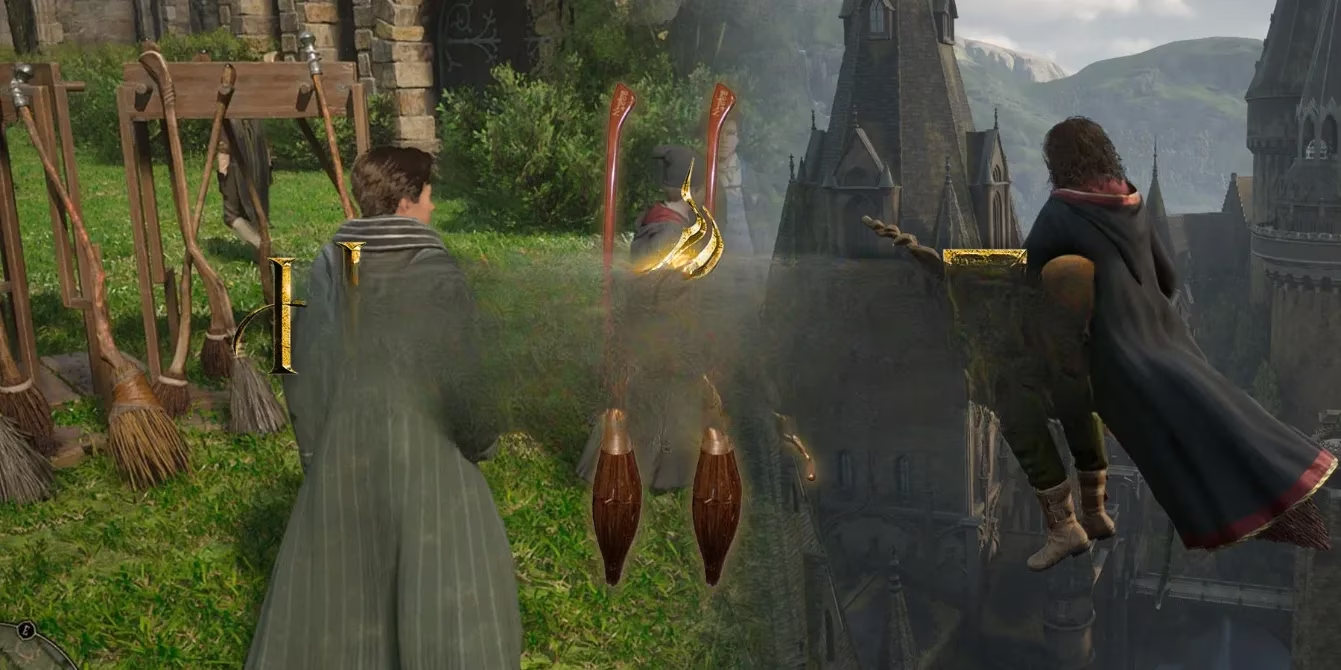
Don’t get me wrong—the flight system in Hogwarts Legacy is beautifully crafted. The sensation of soaring through clouds, dipping low over the Black Lake, or spotting a Merlin Trial from above is pure wish-fulfillment. But here’s the thing: flying never evolves. You learn the basics in Madam Kogawa’s class, and that’s it. No barrel rolls, no dives that actually test your nerve, not even a wobble when you pull a hairpin turn at top speed. After a while, I found myself thinking: is this really the same broom riding that Harry Potter characters trained for years to master?
In the books and films, broomsticks demand respect. They’re fast, temperamental, and in the hands of an expert, capable of breathtaking feats. Hogwarts Legacy strips all that away. You can’t crash. You can’t stall. You can’t even nudge a sheep off a hillside. The broom behaves with the same predictable smoothness whether you’re hovering inches off the ground or plunging from the Astronomy Tower. That safety net is comfortable, yes, but it also makes flying feel weightless—not in the literal sense, but in the emotional one. When there’s no risk, there’s no rush.
That’s why I’ve spent the past two years (and yes, it’s 2026 now, with rumors of Hogwarts Legacy 2 swirling louder than ever) imagining what a sequel could do with a simple addition: broom tricks. Imagine pressing a button midair to initiate a daring inverted flip, or threading through a narrow gorge while balanced sideways on your broomstick. These aren’t just fancy animations—they could be tied to a risk-reward system that makes every flight a miniature adventure.
What if pulling off a corkscrew dive at the right moment gave you a short speed burst to help you reach a timed event? Or if landing a streak of chained tricks in a forbidden forest clearing unlocked rare cosmetic upgrades for your broom? The original game’s gear system already encouraged chasing stats and aesthetics; extending that to how you ride would add a whole new layer of engagement. Suddenly, the skies above Hogwarts wouldn’t just be a commute—they’d be a playground.
And let’s talk about Quidditch. Fans have been begging for a fully playable version since before the first game even launched. If Hogwarts Legacy 2 finally pulls the trigger on the sport, trick-enriched broom mechanics become almost mandatory. Picture yourself as a Chaser, barrel-rolling past a Bludger before slinging the Quaffle through a hoop. Or as a Seeker, executing a sharp S-turn to dodge opposing players while chasing the Snitch. Without tricks, Quidditch would risk feeling as frictionless as the current flight model. With them, every match could feel like a genuine test of skill.
But would adding complexity alienate the casual players who made Hogwarts Legacy such a massive hit? Not if the system is optional. The sequel could keep the core flying as accessible as ever—just hop on and glide—while layering tricks as an advanced skill tree that players unlock through exploration or side quests. Think of it like The Legend of Zelda: Tears of the Kingdom: you can spend hours building intricate machines, or you can stick to climbing and paragliding. The depth is there if you want it.
I’ve already dreamed up a few challenges I’d love to see. A “Dangerous Dives” club questline where you have to fly under stone arches at breakneck speed. Trick-based races against other students that judge you on style as much as time. Even a trick-shot puzzle where you need to knock rune stones mid-flight by executing specific maneuvers. The world of Harry Potter is bursting with whimsy and danger; shouldn’t the act of flying reflect that duality?
Of course, none of this would work without a proper learning curve. In the current game, you can buy an upgrade that makes your broom faster, but the handling remains identical. I want to feel the broom’s temperament change when I’ve upgraded its handling, or when I’m attempting a trick I haven’t yet mastered. Imagine wobbling out of an attempted loop in the early game, then pulling it off flawlessly after hours of practice. That sense of progression would make the bond between player and broom feel tangible—something Hogwarts Legacy only managed in its narrative, never in its mechanics.
The 2023 game laid an incredible foundation. Its open world is one of the most immersive ever crafted in a licensed title, and the simple joy of flying over it still makes me smile. But a sequel in 2026 or beyond has the chance to transform a pleasant sightseeing tool into a genuine gameplay pillar. By weaving in tricks, risk, and player expression, Hogwarts Legacy 2 could turn every departure from the ground into a little story of skill, daring, and magic.
So I’ll keep polishing my Nimbus 2000 imitation and hoping. After all, what’s a witch or wizard without a few reckless stunts in the sky?