 HogwartsLegacyZone
UK video game settings, from London's gritty underworlds to Scotland's haunting highlands, transform the nation into a compelling narrative character.
In the ever-expanding universe of video games, the United Kingdom serves as a remarkably diverse and historically rich backdrop, though perhaps not as ubiquitous as the sprawling cities of the United States or the neon-lit districts of Japan. By 2026, developers continue to mine the UK's unique blend of ancient history, modern culture, and dramatic landscapes to create immersive worlds. From the fog-shrouded highlands of Scotland to the rain-slicked streets of London, these digital Britains offer players everything from heart-pounding crime sprees to serene, narrative-driven walks. The games that choose this setting often do so to capture a specific atmosphere—be it the gritty realism of urban life, the haunting beauty of remote islands, or the whimsical chaos of a rural village—proving that the UK is more than just a location; it's a character in its own right.
London's Digital Underworlds
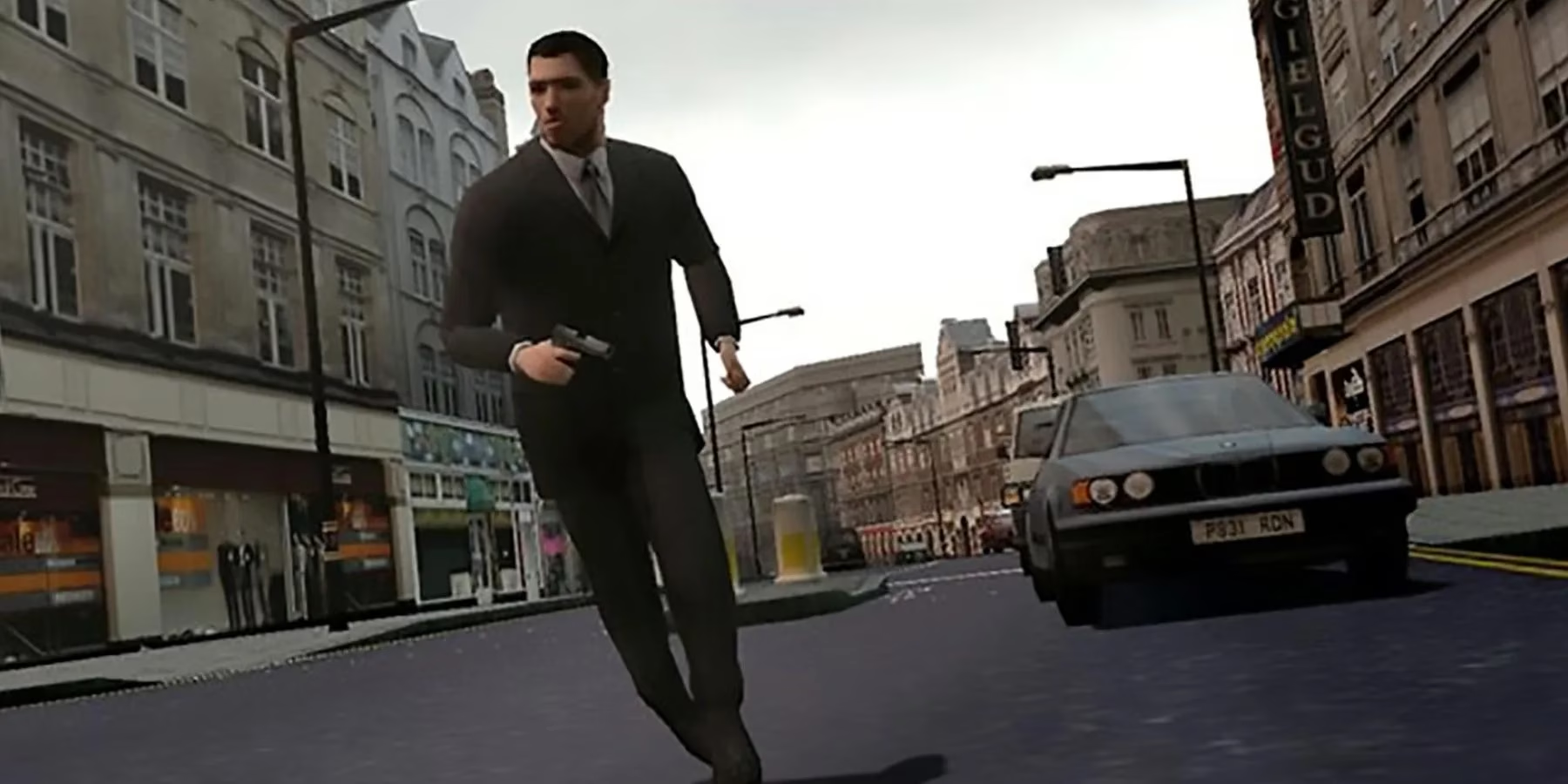
When it comes to urban playgrounds, London is a perennial favorite. The Getaway threw players headfirst into a cinematic rendition of the city's criminal underworld, mirroring the tense, dramatic feel of British gangster films. Controlling characters from a third-person perspective, players navigated a meticulously recreated London, utilizing firearms and commandeering vehicles. The city itself was not just a setting but a narrative engine, its architecture and ambiance fueling the crime-centric story. Like a meticulously crafted diorama of urban tension, every rain-slicked cobblestone and narrow alleyway contributed to the experience.
Years later, Watch Dogs: Legion offered a near-future, dystopian vision of the capital. Shifting the series from American cities to a fictionalized London, it doubled down on the franchise's hacking mechanics, allowing players to recruit and control any citizen in a borough-by-borough resistance against an authoritarian regime. The game presented London as a sprawling network of data and control, where iconic landmarks became puzzles to be solved and fortresses to be infiltrated.
Historical and Mythical Britains
The UK's layered history provides fertile ground for epic adventures. Assassin's Creed Syndicate plunged players into the smoke-choked air of Victorian London during the Industrial Revolution. As twin assassins Jacob and Evie Frye, players navigated a city of stark contrasts: the gleaming new technology and grand architecture juxtaposed with the filthy, overcrowded slums. The game was a love letter to a specific era, complete with a grappling hook for scaling buildings—a gadget that felt as revolutionary as the period it represented. It was the last of the classic Assassin's Creed stealth titles before the series' RPG evolution, making its London a final, polished snapshot of a gameplay style.

Assassin's Creed Valhalla journeyed much further back in time, to the era of Viking invasions in the 9th century. While not strictly set in a unified "UK," it offered a breathtaking and brutal interpretation of Anglo-Saxon England. Players, as the Viking raider Eivor, explored regions like Oxfordshire and Gloucestershire, their lush fields and riverside settlements serving as both homesteads and battlegrounds. The game's depiction of England was like a tapestry woven from history and myth, where every rolling hill and ancient stone circle whispered of older powers.
Of course, the most famous fictional UK setting is undoubtedly the Wizarding World. Hogwarts Legacy finally gave players the keys to the castle, set in the Scottish Highlands in the late 1800s. This open-world adventure allowed exploration of Hogwarts School of Witchcraft and Wizardry, the nearby village of Hogsmeade, and the surrounding wilds. It fulfilled a long-held fantasy, letting players live out the student witch or wizard experience in a location that feels as culturally British as afternoon tea.
Atmospheric Explorations and Peaceful Chaos
Not all UK-set games involve combat or conquest. Some offer quieter, more introspective journeys. Dear Esther, from British developer The Chinese Room, is a pioneering example. Set on a desolate island in the Scottish Hebrides, the game strips interaction down to pure exploration. As players wander the windswept cliffs and dark caves, a fragmented, poetic story is revealed through voiceover. The experience is less a game and more a digital ghost story, with the landscape itself acting as the narrator.

The studio followed this with Everybody's Gone to the Rapture, set in the eerily empty English countryside of Shropshire. Investigating a mysterious mass disappearance, players encounter spectral traces of the villagers' final moments in the form of floating lights and echoes of conversation. The game transforms a stereotypically "quaint" English village into a profound and melancholy mystery box, its beauty hiding an existential puzzle.
On the opposite end of the tonal spectrum lies Untitled Goose Game. This title masterfully captures a very specific kind of British chaos by casting the player as a mischievous goose terrorizing a peaceful village. The humor arises from the stark juxtaposition of idyllic, orderly English life (neat gardens, a quiet pub, a diligent groundskeeper) against the anarchic, honking force of nature you control. It’s a perfect digital farce, as British in its comedy of manners as it is in its setting.
Apocalypses and Open Roads
Even the end of the world finds a unique home in the UK. ZombiU (later re-released as Zombi) presented a grueling survival-horror experience set in a zombie-overrun London. Leveraging the Wii U's gamepad for inventory management and scanning, it made exploration tense and methodical. Scavenging through landmarks like the Tower of London, the game framed the apocalypse not with American bombast, but with a claustrophobic, resource-scarce desperation that felt distinctly suited to its setting.

For a more vibrant and celebratory take on Britain, Forza Horizon 4 built its entire open-world racing playground around a condensed, idealized version of the UK. From the historic streets of a fictionalized Edinburgh to the muddy trails of the Lake District and the cozy thatched-roof villages, the game is a love letter to British motoring culture and landscape. Its revolutionary seasonal cycle—from vibrant spring blooms to snowy winter roads—showcased the country's changing beauty like a dynamic postcard, affecting not just visuals but vehicle handling and available activities. Cruising through this world in a classic Aston Martin is its own form of tourism.

The Enduring Appeal of a Digital UK
As of 2026, the representation of the United Kingdom in video games remains a fascinating niche. These titles demonstrate that the setting is versatile enough to support genres from hardcore simulation to abstract art. The UK in games can be:
-
A historical document: Preserving and interacting with eras from the Viking Age to the Industrial Revolution.
-
A narrative catalyst: Its atmosphere—often gloomy, sometimes whimsical—directly shapes the stories told within it.
-
A character: From London's imposing grandeur to the Scottish Highlands' mystical isolation, the location actively participates in the experience.
While the number of games set entirely in the UK may not rival those set in fictional worlds or other countries, the ones that do exist often leave a lasting impression. They offer players a chance to engage with British culture, history, and humor in interactive ways, whether that means solving a mystery in a deserted village, casting a spell in a Gothic castle, or simply causing a polite ruckus as a feathered menace. In the digital realm, the UK continues to be not just a setting on a map, but a wellspring of compelling and diverse virtual experiences.
Research highlighted by Sensor Tower can help frame why UK-set titles that lean into big, recognizable “tourism” hooks—like landmark-dense London sandboxes or postcard countryside racers—tend to cut through in crowded storefronts: clear setting signals, strong visual identity, and season/event-friendly content loops can all support longer-tail discovery and re-engagement compared with more niche, purely atmospheric explorations.